You don't have to signal a social conscience by looking like a frump. Lace knickers won't hasten the holocaust, you can ban the bomb in a feather boa just as well as without, and a mild interest in the length of hemlines doesn't necessarily disqualify you from reading Das Kapital and agreeing with every word. --Elizabeth Bibesco

Thursday, March 10, 2011

Day 2

0 comments
So I have a big long feminism post that I will finish eventually, but I'm on my second day and I'd just like to throw out a few observations.

1) Living in a co-op (with men) has made this more difficult than it might be otherwise. For instance: It's 2am and I have to go to the bathroom. What do I wear down the hallway? The answer turned out to be a Senegalese pagné (pronounced pawn-yay) and a sweatshirt, but it was a hard call. One thing I love about this is that it makes me aware of God all the time-- which is awesome.
Me and a bunch of other people wearing pagnés.


 2) I walked down the street today and so many people stopped and stared at me that I thought I'd cause a traffic jam. Now, this is Ann Arbor, guys. On campus. I've seen people walking around in fairy costumes that get fewer looks than I did today. And it's not like I was doing something weird. (For instance, the other day, I was wearing a hijab and an ambulance went buy, so I crossed myself. Understandably, someone stared at me-- obviously a little confused.) I was walking down the street in a long, brown coat, a mid-calf-length jean skirt and obnoxiously brightly-colored rainboots. My Woman rated it a 5 out of 10 on a scale of weird Ann Arbor outfits. I just don't get it...

Sunday, March 6, 2011

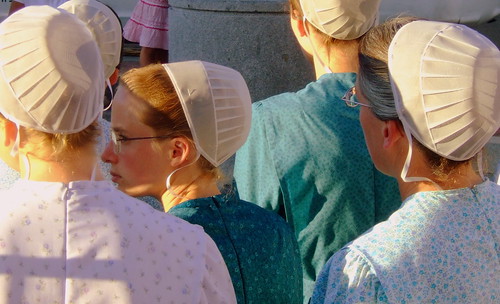
What do you all think about head coverings?

3 comments
I'm not sure how I feel about them. They are, after all, one of the few regulations in Christian scripture about clothing. (Check out 1 Corinthians 11:2-16.) However, so is not cross-dressing and I think I sufficiently pointed out in the post below that I think it's a bit of a crock (even though I plan on only wearing skirts for Lent).

Originally, I was very against them since Paul advocates them as a way for women to indicate they are "good" and also generally submissive to men. Yuck! I have several problems with this.
A) If I want to be "bad" in the way Paul is suggesting, it's between me and God and I don't feel the need to advertise it to the world.
B) What man would I be submissive to, pray tell? My dad? My brother? Some husband that I could conjure up but would only be vaguely attracted to?
C) I don't generally have a problem with submitting to one's significant other, but why doesn't the husband have to submit to his wife? Answer: God's a sexist pig.
I don't actually think this, but I tend to come to that sort of conclusion when I look at head-coverings that way.

The tzniut version is perhaps even worse. Men have to cover their heads all the time-- as a sign of submission to God. Women, on the other hand, have to cover their heads after they get married-- you guessed it, as a sign of their submission to their husband. Problems:
A) Why is man always the conduit between woman and God?
B) They're so close. I was looking this up somewhere (eep! I don't remember which source) and I read, "The object of covering one's head isn't to hide the hair from view [although bear in mind that this is a controversial opinion in Judaism], but to remind the woman that there is someone over her..." Immediately, I thought they meant God and I fell in love with the concept. What a wonderful idea to have a constant reminder that God is in charge, that we are God's hands, God's feet, God's mouths! And then they continued, "to remind a woman of her submission to her husband." Crap, crap, crappity crap. Shot down.

And then Mary suggested going Plain, Quaker style and I found Quaker Jane.
 Now, I'm not going to go Plain for a variety of reasons that I will discuss another time. BUT! Her thoughts on headcoverings seemed rather congruent with some of mine (because, surprise! mine don't always agree with each other).
She says the following about it:
"For starters, it reminds me that God comes first. In my previous condition, I came first and a great concern for my and other women's position in the world came first. My feminism came first. It came before God. It came before my marriage. It came before happiness. I did not know how to trust my husband, as from my viewpoint he did not have my best interest at heart. I believed I had to have a hand in every decision that was made, indeed control most everything, or it would not be the best decision, or even an okay decision."
Now, I don't feel the same way about all that. And I shall write a post about modesty and feminism one of these days, but today is not that day. HOWEVER! I just about swooned reading that first sentence. I do need a daily reminder that God comes first. I'm using tzniut that way for Lent, but what about when Lent is over?

Story time:
I work in a "dining hall" (not a cafeteria) on campus washing dishes. In order to make sure I had all the pieces of my outfit right, last Monday, I wore our uniform t-shirt with a past-knee-length-skirt, knee-high socks and a long-sleeve shirt underneath. It was hot as all get out. Also Mondays I work with someone who I don't have the nicest feelings toward. I often spend Mondays at work thinking, "Are you stupid or are you just trying to piss me off?" Not very Christ-like. Wearing all these layers, I was getting irritated a lot faster than usual and contemplated throwing dishes at him. Finally, I remembered-- the whole reason I was subjecting myself to the sweaty grossness was so I would remember to pray and be Christ-like. I breathed a lot easier after that. I'm still not sure if that guy is just stupid or trying to piss me off, but I don't hold it against him as much now.

I wonder if covering my hair would work like that once Lent is over. Or would I become accustomed to it and not think about it any more? I just keep getting drawn to head coverings...

On the other hand, my hair desperately needs to be cut, so maybe it's just that...

But I have been drawn to head covering for as long as I can remember...
And there are so many kinds!
PS. Points if you can figure out what denomination/religion all these head coverings are from!

I, and Hafiz, think God is pretty ok with drag

0 comments
I knew I couldn't have been the first person to have thought of this.

Corroboration of the idea that "We are born naked and the rest is drag" by a suffi poet, Hafiz.
The Sun in Drag, by Hafiz

You are the sun in drag.
You are God hiding from yourself.
Remove all the “mine” – that is the veil.
Why ever worry about
Anything?
Listen to what your friend Hafiz
Knows for certain:
The appearance of this world
Is a Magi’s brilliant trick, though its affairs are
Nothing into nothing.
You are a divine elephant with amnesia
Trying to live in an ant
Hole.
Sweetheart, O sweetheart
You are God in
Drag!

Tuesday, March 1, 2011

What God Wants Me to Wear, Part 2

0 comments
Okay, so there's a line in scripture (Deut. 22:5) that says: "A woman shall not wear anything that pertains to a man, nor shall a man put on a woman’s garment, for all who do so are an abomination to the Lord your God." This is oft-quoted as why tzniut women should not wear pants. I believe a good handful of other religious groups follow this as well (think Mennonites, Seventh-Day Adventists, etc).

Yeah... but Jesus says: (in Matthew 6:28-32) "Why do you worry about clothing? Consider the lilies of the field, how they grow: they neither toil nor spin; and yet I say to you that even Solomon in all his glory was not arrayed like one of these. Now if God so clothes the grass of the field, which today is here, and tomorrow is thrown into the oven, will He not much more clothe you, O you of little faith?
 Therefore do not worry, saying, "What shall we eat?' or "What shall we drink?' or "What shall we wear?' For the Gentiles run after all these things, and your heavenly Father knows that you need them."
Jesus asks us why we worry about what we wear. I feel like the clueless disciples. "Well, uh, Jesus, we're pretty sure God told us to..." But Jesus is presenting us with this idea that maybe we're wrong.

So how did we go from God-vehemently-hates-women-wearing-pants-and-men-wearing-skirts to God-says-don't-worry-about-your-clothes?

Let's look back at the Deuteronomy quote. I'm going to interpret it as the Bible saying God doesn't want us to dress in drag. In analyzing this interesting piece of scripture, I'm going to quote well-known theologian :) RuPaul, who says, "We're born naked. The rest is drag." Therefore, I'm going to extrapolate that God doesn't want us clothed. This actually might not be that far off. God created us naked and then we Fell. We Fell and were ashamed of the beautiful bodies God gave us, so we decided we needed to cover them up. If I made a masterpiece of a sculpture and gave it to you and you decided to put a blanket over it, I'd be pissed. I wonder if that's how God feels. Looking at it that way, maybe my Lenten discipline shouldn't be to follow more strict rules about clothing, but not to wear clothing at all. Unfortunately, I think that's illegal. So, I guess we should continue the analysis.

Short of moving to a nudist colony, I have to wear clothes sometimes. What does God say about that? Well, let's check out Matthew 6:32 again. "The Gentiles run after all these things and your heavenly Father knows you need them." To me, that sounds like God sighing and saying, "Wear clothes if you must, but don't fuss about them, okay guys?"

Oops. Amn't I doing just that? Worrying about my clothes? Then I should tread very lightly on this Lenten discipline of mine. The last thing I'd want is to turn worrying about my clothes into some kind of idol. The goal is wear these clothes and any time I'm about to worry or fuss about them, I pray. And maybe God is just shaking God's head at all this BUT, I sometimes think God must shake Her head throughout all of Lent-- like, hey guys, I gave you food, why are you ignoring it? Hey guys, you've got enough suffering on this earth, why are you inducing more of it for yourself? Who knows? If I'm wrong (and at least part of me has to be wrong, since I'm thinking conflicting things), I imagine God is just giggling and patting me on the head and murmuring, "It's okay, darling," as I fuss.

Tuesday, February 22, 2011

What God Wants Me to Wear, Part 1

2 comments
Okay so, Orthodox Jews, Muslims, Amish, Mennonites, Mormons, Fundamentalist Mormons, Catholics (that's approximately 2,339,803,500 people)... everybody thinks God has an opinion on what I wear. Many of them disagree about the specifics, but all those people think God is pro-dress-code. This makes me wonder, does God care what I wear? So, in the next couple of posts, I'm going to look at the rationale behind religiously-motivated dress codes and re-think some of my own ideas about God and clothing.


One of the reasons I picked tzniut (versus, say, following Muslim dress code rules or Mormon dress code ruels) is because of the reasoning behind it. Of course, they have the obligatory women-should-cover-up-so-men-don't-succumb-to-temptation clause (more on that another time). However, they also say that the reason there are clothing rules for b'nei Ysrael (children of Israel) and there aren't for b'nei Noach (children of Noah-- ie. the rest of us), is because Jewish people, as God's chosen people, should be dressed like royalty. I like that, but it runs contrary to many other beliefs about clothing and religion.

Often, the goal of Christian modesty rules, at least as far as I can tell, is so girls and women don't draw attention to themselves. Hence why many denominations insist their women dress the same way. I've never bought this explanation. Of course, that's certainly one way to learn humility, but it's always rubbed me the wrong way. God made us unique for a reason. We all stand out in God's eyes, don't we? So I think if we're trying to "blend in" it ends up being more about shame than humility. Shame about our bodies brings us back to the Fall-- Adam and Eve at the fruit from the tree of the Knowledge of Good and Evil and their eyes were opened, they saw they were naked and they were ashamed. That shame about our bodies was the first result of our Fall. I don't think Christianity should aim to replicate that in it's clothing.

So what about this "royalty" concept?
This reminds me of when I was writing health curricula.One of my tasks was to create a lesson about sexual abuse/"where no one has the right to touch us"/Good Touch-Bad Touch. Well, we know the Good Touch-Bad Touch curriculum  was a failure. If you have any doubts about this, feel free to ask my Woman-- she'll tell you about how some of the 5th and 6th graders at the summer camp she worked at last year developed a game called Bad Touch Tag.
So I was looking for better models than that and I found a lesson from a Christian curriculum that I liked. The day before, you asked the children to bring in an object that was valuable to them. When they brought it in, everyone had the chance to show it off in front of the class. Then, you asked questions like, "Do any of you keep these in a special place?", "Do you only take these out on certain days or for certain things?" and finally, "Are only certain people allowed to touch these?" After that last question, ask them why. Maybe prompt them with an example: Ask if anyone has a younger sibling. Pick someone and ask, "[Annie] is your [sister] allowed to [wear] your [locket]?" When the answer is no ask why. Inevitably, you will hear at least somewhere in this something like, "Because it's mine and it's special to me." Then you say: "Our bodies are like that. Our bodies belong to us and God and they are special to God." You go on from there about the who/where/how/when of touching.

Maybe, this dressing like royalty is simply a way of saying, "My body belongs to me and God and it is special to God." Just like Annie might keep her locket in a special compartment in her jewelry box, I'd keep my body in special clothes, be they tzniut or hijab or temple garments or what-have-you. Does that make any sense?

Friday, February 18, 2011

"That doesn't tell me anything": Further explanation

4 comments
So, I figured I'd dedicate this particular post to explaining various versions of religious modesty as I understand them, in order to explain why I picked tzniut, as well as highlight as many of the tzniut rules (guidelines?) as I can. Since this is all rather controversial (ask 5 Orthodox Jews what the rules for tzniut are and you'll get 6 opinions), I'm citing my sources. (Yes, I know I'm a dork.)

First, some thoughts about Christian modesty laws.
Catholics:
Pope Pius XII (think 1940's-1950's Catholicism) declared that good Catholic women should cover their upper arms and shoulders and they shouldn't wear "men's clothing," under which he included both "trousers" and tights. Tights?!? Tights?!?! When was the last time tights were primarily men's clothing?? Anyway, he also said that skirts should cover a woman's knees and necklines should not reveal "anything" (whatever that means).
--Wikipedia
The Magisterium on Christian Modesty (from 1998) says clothes should hide the shape of the body, rather than accentuate it. Women shouldn't wear "slacks or culottes." A woman's skirt should cover her knees when she is seated. Also, they say that women should cover their hair when they pray. Why? "It is a sign of humility and submission for a woman to cover her head, and draws down God's graces and blessings upon her."
--http://olrl.org/virtues/modcrus.shtml
Mormons:
The Church of Jesus Christ of Latter-day Saints (the Mormons) "discourages" extremes in clothing or hairstyles (again, whatever that means), and "clothing which can stimulate sexual desires" under which they include short shorts, mini skirts, tight clothing, strapless things and shirts that don't cover the stomach. Also, they "discourage" women wearing more than one pair of earrings.
--Wikipedia
Seventh-Day Adventists:
 The Adventists, as far as I can tell, advocate "simple, modest and neat" manners of dress and women wearing skirts (although I don't know how global either of these are to the denomination).
--http://www.adventist.org/beliefs/fundamental/index.html
I'm not including the Mennonites, Amish, Quakers and Brethren (and probably many others), because many of them wear a "uniform" rather than having a "dress code."
That's not to mention priests who, at least in the Catholic church, are required to wear clerical vestements (the black pants, black shirt and collar).
http://fatherjoe.wordpress.com/2006/05/06/clerical-clothing-what-do-priests-wear/
Episcopal priest are, as far as I can tell, not required to wear the collar, but can and many do. (There's a surprise-- something in the Epsicopal Church that's optional!)
Then there are nuns, who often have uniforms too...

Oh man, that was a digression.
Anyway, I'm Episcopalian and the Episcopal Church doesn't have a dress code (even an optional one in most churches), so going with my own denomination's wasn't an option. And Christianity seems SO variable. The only dress requirements in the New Testament are in 1 Corinthians 11:3-16, where women are required (by Paul) to cover their heads when they pray.
1 Corinthians 11:4-6
Every man who prays or prophesies with his head covered dishonors his head.  But every woman who prays or prophesies with her head uncovered dishonors her head—it is the same as having her head shaved.
However,  a few lines later, Paul explains that "long hair is given to her [woman] as a covering." So maybe that's only a commandment not to shave your head? And does that mean all men should be shaving their heads before coming to church? And anyway, Paul rationalizes this all by saying
"the head of every man is Christ, and the head of the woman is man," which I think is crap, so... throwing that one out the window.

Anyway, so then I moved on to other Abrahamic religions, because we are brothers, in a sense. However, Muslim modesty rules have always irked me. Not necessarily because of anything inherent about them, but more in how I've heard them presented.
Anecdote:
While I was studying in Senegal, one of the people in my Islam in Senegal class brought up the headscarf. (Now, certainly not all Senegalese women wear headscarves, but many of the very religious Muslim ones do.) The professor proceeded with this explanation, thinking it was the most logical thing in the world. "If I leave my meat uncovered outside and the dogs and the flies get at it, who's fault is it?" Ew. I realize that that would probably not be the Prophet Mohammed's response, but I've heard that kind of thing enough that it really irks me.

Next! Jewish modesty rules. Well this is interesting. I'm pretty sure when I was little, I thought all Jews followed these rules (clearly, I didn't know many Jews). I really liked them then, PARTICULARLY because in my understanding at the time, both men and women followed pretty much the same rules. As an adult, I was attracted to them because one  of the first rationales I found for tzniut was Micah 6:8 where we are commissioned to "Do justice, love kindness and walk humbly with your God." That last part, "walk humbly with your God," eventually became translated into a dress code for all Orthodox people.

Now, in an effort to get the best explanation about what tzniut actually entails, I spent a lot of time on the internet. :) This might be an oxy moron, because many Orthodox Jews eschew the internet. Oh, well. So here are the various rules I've found and where they come from.
  • Sleeves should cover the elbows
  • Shirts should cover the collarbone
  • Skirts should cover the knees with or without tights
  • No pants in the presence of men.
  • Some Modern Orthodox women will wear sleeves up to a fist's length (tefach) above their elbows or even wear short sleeves, and some do not cover their collarbones. In left wing Modern Orthodox Judaism, some women will also wear loose pants, as long as they are loose and cover the knees.
  • In Haredi communities, men generally wear long trousers and often long-sleeve shirts (covering the same parts that women do).
    • Wikipedia/davening.net
  • Skirts should cover the knees, even when women sit down
  • Shirts must cover elbows, even when women reach up
  • Legs should be covered with stockings or tights
  • Open-toed shoes are not allowed
  • Colors should be subdued
    • beingjewish.com
  •  Unmarried women should keep their hair short (shoulder length) or keep it tied back.
  • The idea is called kol kevuda bas melech penimah, which means that Jewish women should look like royalty, as far as I can tell.
    • frumteens.com
Phew! Busy women! For my Lenten exercise, I decided to pick a moderate level of tzniut, one that I could manage, but would be a challenge. (For those who don't know my philosophy about Lent, I'm generally of the opinion that a Lenten discipline's primary job is to be a pain in the ____ in the name of God. That way, when you're grumpy and like "Why did I decide to do this, for Heaven's sake?", it's a mental reminder to pray.)

The rules I'm applying are: Tops will cover my elbows and collarbones. I will wear skirts or dresses in front of men. My skirts or dresses will cover my knees. Since I'm not married, I'm not worrying about covering my hair and it's not even long enough to pull back so I'm not doing that either. I hope to be good enough about blogging that I can keep the internets updated with how my life, and especially my prayer life, ends up going.

"You're doing what?": An answer to my mother's question

0 comments
So, this is an odd thing for my mother especially because we grew up in the Presbyterian Church, which, for the most part, doesn't make a big deal about Lent. It exists, sure. And sure, you could do something if you wanted. But that's about it. I, however, became an Episcopalian a few years back and Episcopalians (especially if you're High Church like me) take Lent seriously. Very seriously.

Traditionally, people give up something like candy or caffeine or some other luxury food for Lent. In Senegal, they actually fast like Ramadan, not eating during the daylight for Lent. (I'm pretty sure this is just to prove to the Muslims that Christians can have discipline too.) Most also don't eat meat on Fridays. Well. I don't eat meat. Ever. So that's rather blah for me. And I'm in recovery from an eating disorder. It was years ago (over 4 now) but, like recovering alcoholics don't drink alcohol socially, I can't diet socially (or religiously). If I really wanted or felt obliged to give up some luxury food, I would have to do it under the supervision of a doctor. Yeah right.

So, I've generally made a tradition of "taking on" a discipline instead of giving something up. Unfortunately, my first year I took on reading the Gospels and ended up cramming all my reading into Maundy Thursday and Good Friday. Oops. Another time, I took on praying (from the Book of Common Prayer) 5 times a day. I definitely bit off more than I could chew on that one.

This year, I don't really remember how I decided to go tzniut for Lent. On the one hand, I'd been thinking about Christian modesty rules since September. I got in to a Fundamentalist Mormon kick, since I'd been writing a paper on polygyny, and it just struck me as interesting that this group of people (or many of them, because they are definitely not a homogenous group) believes that God wants women to wear prairie dresses. There are a lot of other variants of Christian modesty and I'll talk about that in my next post, but that definitely got me started thinking, anyway.

On the other hand, I'd gotten my hair cut really short at the beginning of the school year and I wasn't a huge fan, so I started wearing my headscarves more. Now, I'd been wearing headscarves on and off since I was in Senegal, but I started wearing them more often and in more different styles. Particularly, I found that when I covered it in a more Muslim-looking style, à la the hijab or the shayla.
Wearing it like this, I'd noticed I got treated differently. People looked at me longer in general. Men (and women, but mostly men) that I'm assuming were Muslim gave me a kind of head-nod that reminded me of what a friend of mine calls the "Hello-fellow-homosexual" head-nod. When you recognize someone else who is obviously gay, you give them a friendly nod and a smile to say, "Hey, I'm gay too." This one looked like a Muslim head-nod, or maybe just a religious head-nod. Either way, it was interesting.

So, I started researching opinions and facts about religious modesty rules regarding dress. There are so many of them, which I will tell you all about in my next post! Suffice it to say that the Orthodox Jewish style of modesty, called tzniut or tznius (depending on your transliteration of the Hebrew) 'clicked' with me enough that I picked it as my Lenten discipline... in December.